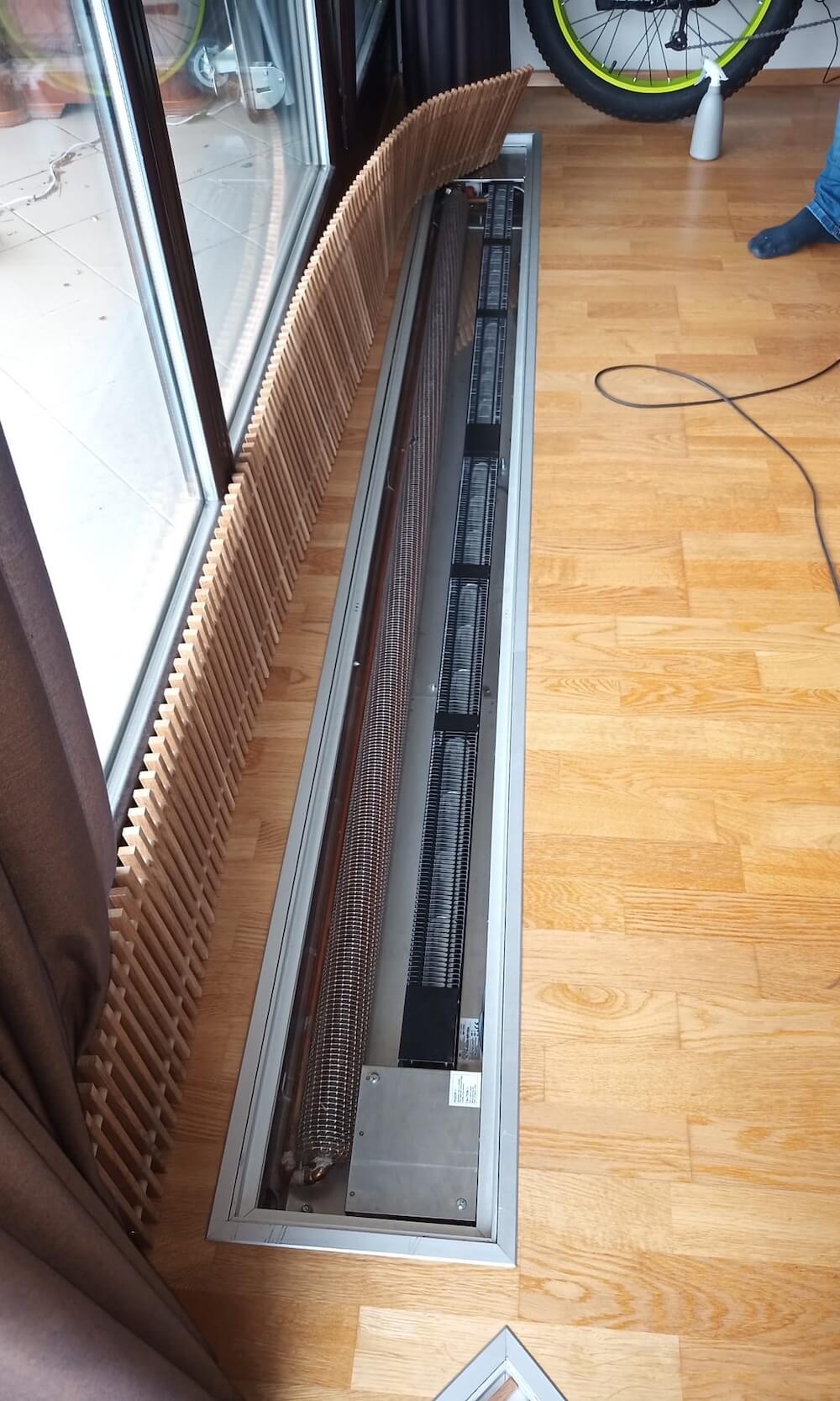
A great many buildings still have floor convectors that have been installed for years. Some run as passive units with no fan at all; others have old fans that, after years of service, start to rattle or simply give out. In neither case does the whole convector necessarily need replacing. We sat down with Josef Just, founder of the Czech fan manufacturer Elsymco, to talk about when it's enough to retrofit an existing convector with a fan, when a full fan-unit replacement makes more sense, and why this matters especially for heat pumps and low-temperature heating systems.
Editor:What problems do you see most often in existing floor convector installations?
Josef Just:I'd split it into two cases. First, convectors that already have a fan but, after years of operation, it's become noisy or is on its way out — usually all you need there is a fan swap, as long as the tray and the heat exchanger are still in good shape. Second, passive convectors with no fan at all, whose real-world output is often very low — typically behind large windows, or after switching to a heat pump — and there, retrofitting a fan is what helps. In both cases the goal is to get more out of what's already installed in the building, not to sell new units.
Why can a passive convector with no fan perform so poorly?
Josef Just:Without forced airflow, a convector depends entirely on natural "chimney" draught, which is very weak in shallow trays — often only around 8–10 cm deep. Large glazed surfaces add cold air falling from the window on top of that. The heat exchanger stays warm, but very little of that heat actually reaches the room.
Does that mean a convector's catalogue output doesn't match reality in a specific building?
Josef Just:Exactly — the stated output applies to laboratory test conditions, while in practice the actual channel depth, grille type, glazing and water temperature all matter. That's why I so often hear the complaint that the convector is warm, but the room stays cold. The problem is usually not the heat exchanger — it's the missing airflow through it.
How does adding a fan change how a convector like that works?
Josef Just:The fan forces air through the exchanger's fins, so heat output stops depending on weak natural convection. The exchanger that's already there in the convector suddenly gets properly used — with no demolition of the tray and no work on the floor. We always start by checking whether the existing convector can be improved this way, before we even talk about replacing the whole unit.
Earlier materials mentioned output gains of over 1,000% — isn't that misleading?
Josef Just:I understand it sounds extreme, but the fan doesn't create heat — it just lets you use what's already in the exchanger. If the actual heat transfer from a passive convector with a shallow tray and cold air off the window was practically zero, then even a modest absolute gain looks enormous as a percentage once you install a fan. It's not that the heat source suddenly produces more — it's that airflow finally gets going, and without it the exchanger simply couldn't work efficiently.
What does this mean for heat pumps?
Josef Just:A heat pump is most efficient at a low flow temperature, but passive convectors are sensitive to that drop — a cooler exchanger means an even weaker natural draught. Forced airflow helps the exchanger keep working even at a lower temperature, so existing convectors can be adapted for heat-pump operation without replacing the whole heating system.
And condensing boilers?
Josef Just:The same logic applies. A condensing boiler works best when the water returning to it is as cool as possible, which requires a low supply temperature. If convectors can't heat adequately at a lower temperature, users turn the temperature back up and lose the condensing effect — better heat pickup thanks to a fan can help prevent exactly that.
The second problem is old fans. Why do they become so annoying after a few years?
Josef Just:Older installations often used AC motors that weren't quiet even when new. After 15–20 years you also get bearing wear and unbalanced impellers, and the vibration gets amplified by the convector's metal tray acting as a resonating box — so the user hears not just the fan itself, but the whole structure buzzing along with it.
Why replace an old fan like that outright rather than repair it?
Josef Just:A fan is usually built as a single, non-serviceable unit, so taking apart the motor or bearings for repair rarely makes technical or economic sense — and even after a repair, you're left with the same old, noisier design. Swapping in a new Elsymco fan, matched to that specific convector, gives a more predictable and longer-lasting result.
What sets Elsymco fans apart from a plain like-for-like swap?
Josef Just:Elsymco has spent 18 years as both developer and manufacturer, including our own patented EC motors designed in the Czech Republic. Because we control our own R&D, we control noise, power draw, controls and the dimensions of the whole unit — and that shows up most in flats, offices and hotels, where users notice any intrusive sound immediately.
Does the retrofit require construction work?
Josef Just:Usually not, as long as the tray and exchanger are in good condition — the work focuses on the fan, power supply and controls, with no work on the floor. Depending on complexity, it can be handled by a heating engineer, a service company, or even a handy end user. The goal is a quick, clean upgrade, not renovation for its own sake.
When should a convector owner consider contacting the fan manufacturer?
Josef Just:It's worth it in a few situations:
What should a client or installer send in for an initial assessment?
Josef Just:Usually a handful of photos is enough — the convector with the grille removed, the tray dimensions (length, width, depth), a photo of the exchanger, and information about the heat source. If there's an old fan inside, it also helps to photograph its rating plate and how it's wired.
Can literally every unit be modernized this way?
Josef Just:No, and I wouldn't be honest if I said otherwise. If the exchanger is damaged, clogged, air-locked, or doesn't get enough water flow, a fan on its own won't fix the problem — the same goes for a tray with no room to mount one safely, or wiring that can't provide adequate power. That's why we always start with an assessment of the specific case.
How would you sum up the main benefit of a fan-based modernization?
Josef Just:The owner doesn't have to plan straight away for an expensive full convector replacement. For passive units, it's mainly about a genuine boost in output; for older active units, it's mainly quieter, more reliable operation. We focus on exactly these two scenarios: retrofitting convectors that have no fan, and replacing old, noisy units with modern, quiet EC solutions.
Send us a few photos of your convector and its basic dimensions — we're happy to give you a preliminary read on whether an Elsymco fan retrofit will do the job.